On October 17, 2025, Andrej Karpathy engaged in a more than two-hour deep conversation on Dwarkesh Patel’s podcast, systematically articulating the forward-looking concept of “Decade of Agents” for the first time. This reminded the author of the Gartner AI Hype Cycle.
Looking back from the start of the fourth quarter of 2025, the period since ChatGPT’s release on November 30, 2022 has traced a complete AI wave: collective strategic misjudgment, explosive enthusiasm, and then a more rational recalibration of expectations. The sequence closely follows the classic technology hype cycle.
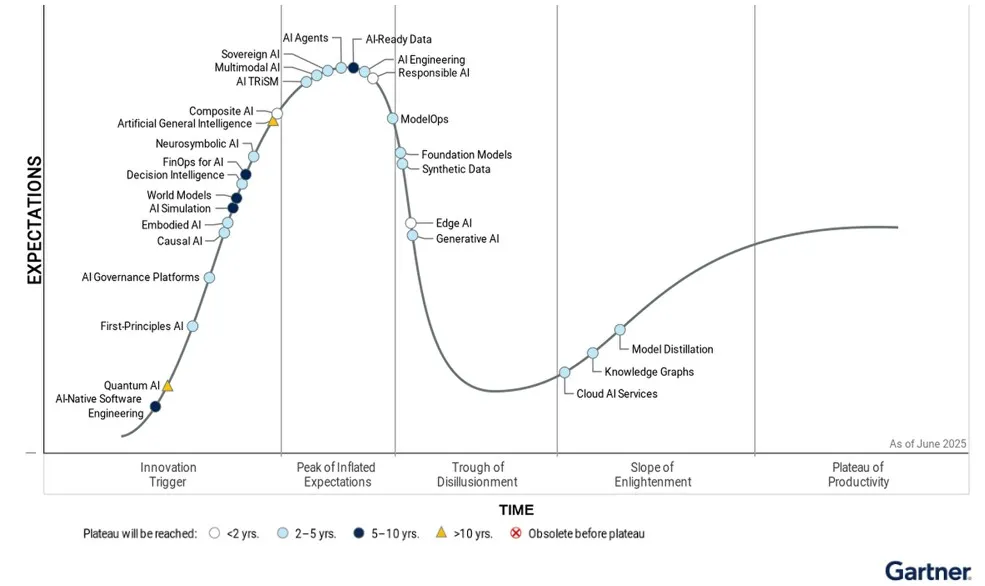
The innovations themselves move along the curve toward maturity or obsolescence; it’s we humans that “cycle” around between enthusiasm and disillusionment. Jackie Fenn, Gartner
As Gartner’s insight reveals: “It’s we humans that ‘cycle’ around between enthusiasm and disillusionment.” Currently, the AI field is approaching the critical node transitioning from the “Trough of Disillusionment” to the “Slope of Enlightenment.” This article aims to return to the application essence of AI-Driven Drug Discovery (AIDD) and explore with readers those practical approaches that have already shown commercial value and are maturing in their technical paths.
The classic IT management work “The Phoenix Project” articulated the DevOps Three Ways, revealing the essential laws of modern enterprise operations. This pattern spans from the 1950s industrial management era, 1970s computer systems engineering era, 2000s digital management era to today’s intelligent transformation era, with the core principle remaining consistent. History repeatedly confirms the simple truth of “No Silver Bullet,” just as people’s cognition of AI gradually returns to rationality in 2025.
The core of enterprise intelligent upgrade lies in building the organization’s neural center and value creation engine. This systematic goal, from the earliest management practices to today, has always followed three fundamental principles:
- Step 1: The Flow Principle — Establish end-to-end value flow systems
- Step 2: The Feedback Principle — Build fast and effective feedback mechanisms
- Step 3: Continuous Learning and Experimentation Principle — Cultivate organizational learning and experimentation capabilities
From the kanban system that helped Toyota pioneer lean manufacturing in the 1950s to the information systems that enabled Dell’s direct-sales model in the 1980s, the central business problem has remained the same: how can value flow efficiently, iterate quickly, and evolve continuously? AI introduces a consequential change. Business logic expressed in natural language can increasingly function like code, allowing organizations to manage more complex systems and build these value cycles at greater scale. In practice, that requires end-to-end semantic mapping across business logic, data, and algorithms. As one account of semantic governance puts it:
By constructing enterprise-level business ontology and achieving full-link semantic mapping, semantic governance provides a new solution for data management in the AI era, helping enterprises better cope with complex business environments and rapidly changing market demands. Yawtti Technology, “New Technology Exploration”
As shown in the figure, business entities (personnel and non-personnel business entities) correspond to blue boxes, the data they generate and corresponding semantic entities correspond to green boxes, and algorithmic entities (including AI models and traditional software) correspond to purple boxes. This cycle achieves unity of value flow, rapid iteration, and continuous evolution in a broader semantic space.
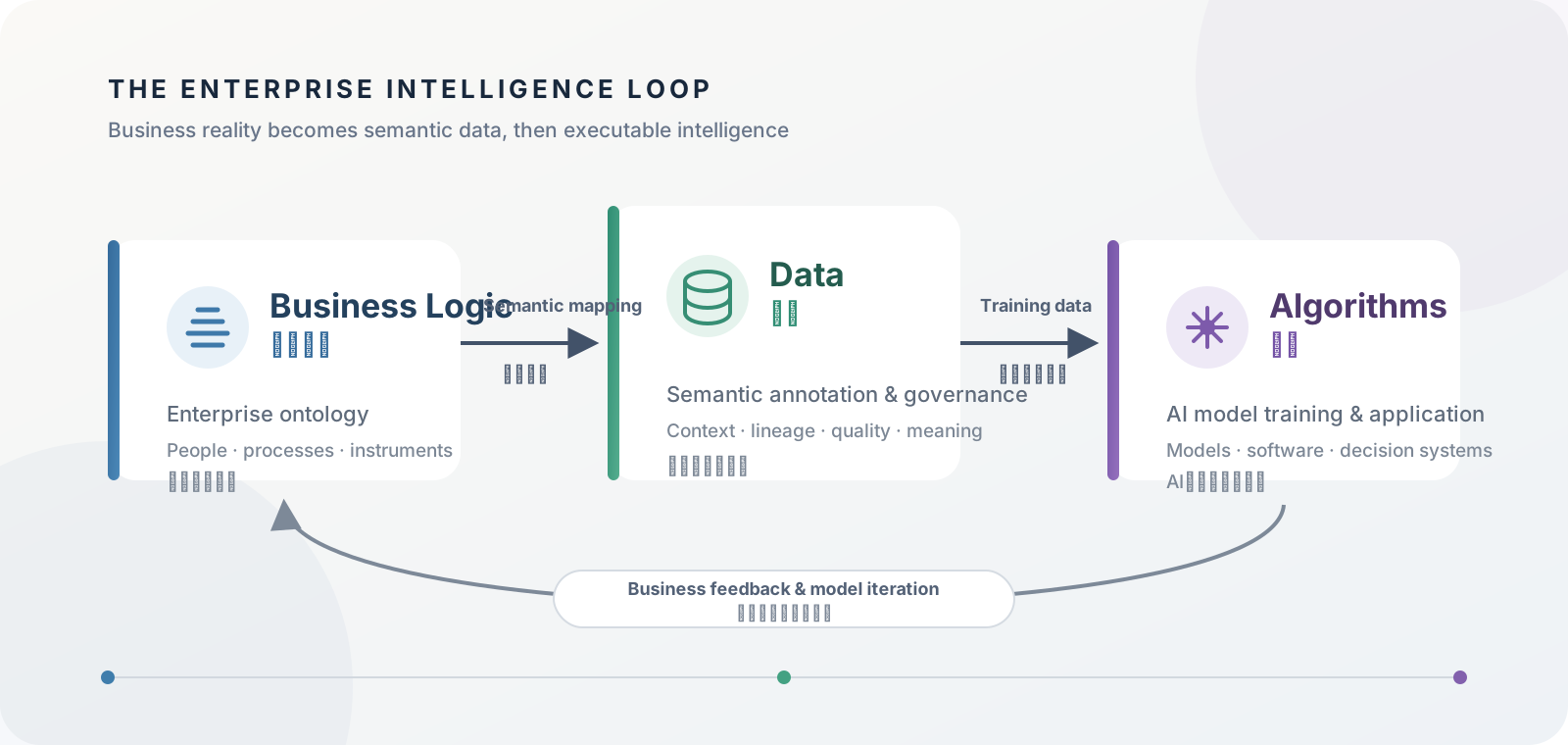
In actual operations, the construction of business entities will show differentiated characteristics due to industry specificities, with the core being closely aligning with main business logic and dynamically adjusting according to scenario requirements. However, correspondingly, the organizational structure of data and algorithm teams has strong replicability, similar to the evolution path of enterprise-level IT teams in the 2000s, and has already formed relatively mature best practices.
On October 9, 2025, top AI investment institution Andreessen Horowitz (a16z) published an AI-era software engineering system architecture diagram on their blog. This architecture diagram not only outlines the organizational vision of software engineering teams driven by AI but also systematically displays various functional modules and their corresponding startup ecosystem, providing the industry with a complete infrastructure (Infra) reference framework.
The Trillion Dollar AI Software Development Stack a16z
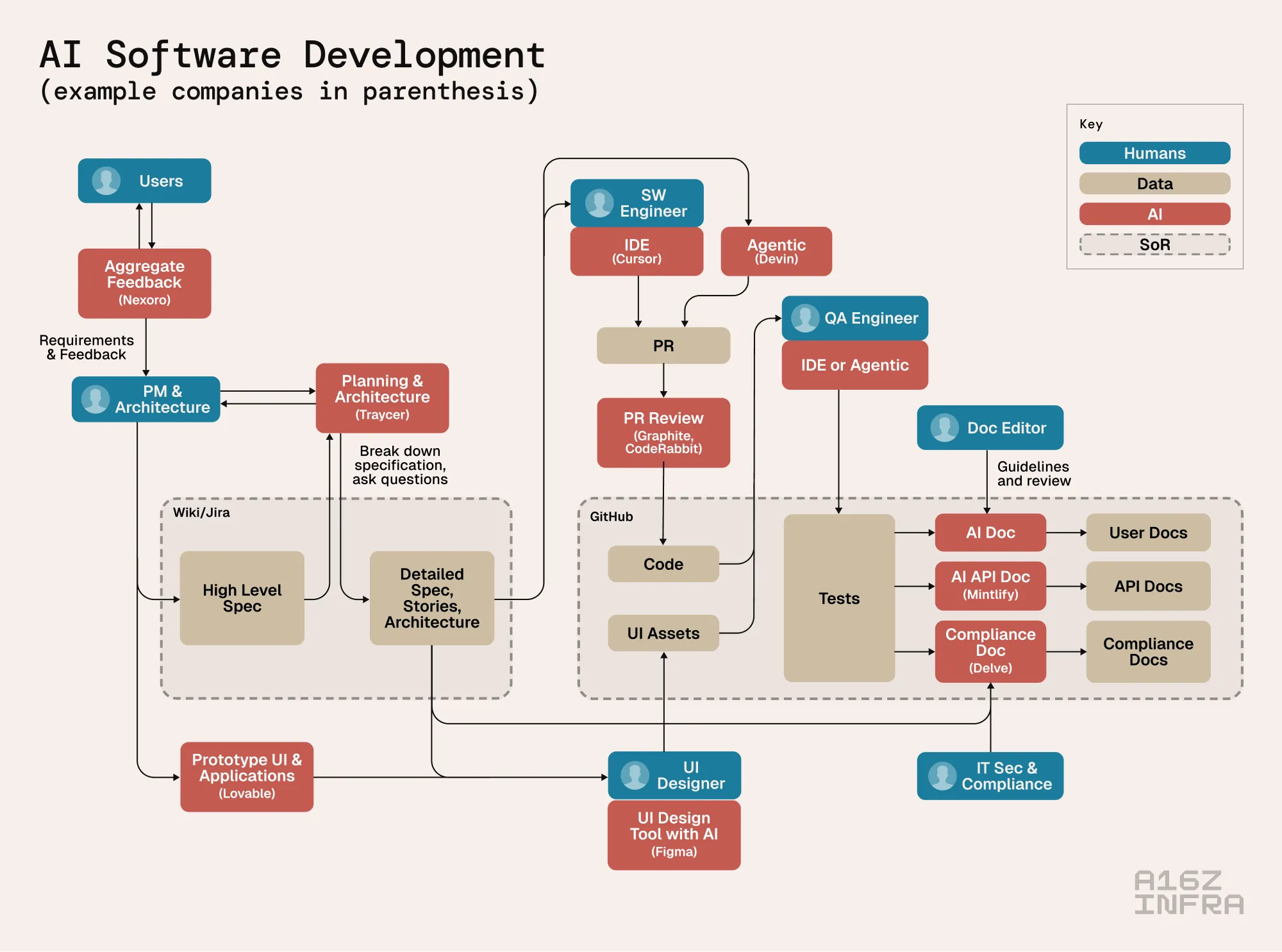
From the architecture diagram, it can be clearly seen that software engineering teams driven by AI present a brand-new organizational form. Specifically, human role nodes directly control AI Agents, or indirectly steer the code generation process through structured data in natural language carrier (Data). Among these, the specification documentation system represented by Wiki/Jira (High Level Spec + Detailed Spec, Stories, Architecture) carries the core expression of business logic. From the AIDD (AI-Driven Drug Discovery) industry perspective examining the human organizational structure (Humans) in the diagram, a clear three-layer division of labor system can be mapped:
-
Business Layer (Blue Box): Users, as the frontier role of business execution, in the AIDD scenario cover medicinal chemists, computational biologists, clinical research coordinators, and medical affairs teams. This level also includes non-personnel business entities such as high-throughput screening (HTS) platforms, single-cell sequencers, and automated liquid handling workstations. They directly produce and consume data, being the direct creators of business value.
-
Semantic Layer (Green Box): The key of this layer lies in transforming domain expertise into executable system architecture. In traditional software engineering, this function is undertaken by product managers; while in the AIDD field, compound talents with pharmaceutical and software engineering experience are needed, such as product architects with pharmaceutical backgrounds or scientific computing experts. They can systematically decompose complex business processes into semantically clear functional modules. With AI Planning & Architecture tools (such as antibody design workflow orchestration platforms or clinical data management systems), these roles build bridges connecting scientific problems with technological implementations through semantic abstraction engineering.
-
Algorithm Layer (Purple Box): The traditional software engineer role evolves here into AI systems engineers, who master both AI thinking patterns and software engineering practical capabilities. Through direct or indirect interaction with AI tools and code review systems, they transform abstract requirements from the semantic layer into AI+algorithm hybrid solutions.
Such an architecture naturally becomes more antifragile. It improves the organization’s ability to manage complexity while preserving an evolutionary logic familiar from earlier changes in how businesses built their core operating systems.
-
Industrial Management Era: Dominated by the Flow Principle. Ford’s assembly line standardized production method, combined with the backward information technology at the time, made production scale the core of competition, but also limited enterprises’ speed in responding to market changes.
-
Digital Management Era: The Feedback Principle became dominant. Zara maximized this advantage in the fast fashion field through PDA real-time collection, ERP systems, and automated distribution, but essentially it still passively responded to the market relying on preset rules.
-
Intelligent Management Era: Continuous learning principle is becoming core. Like the aforementioned business logic-data-algorithms cycle, decision systems achieve self-iteration and capability improvement through continuous interaction with the environment.
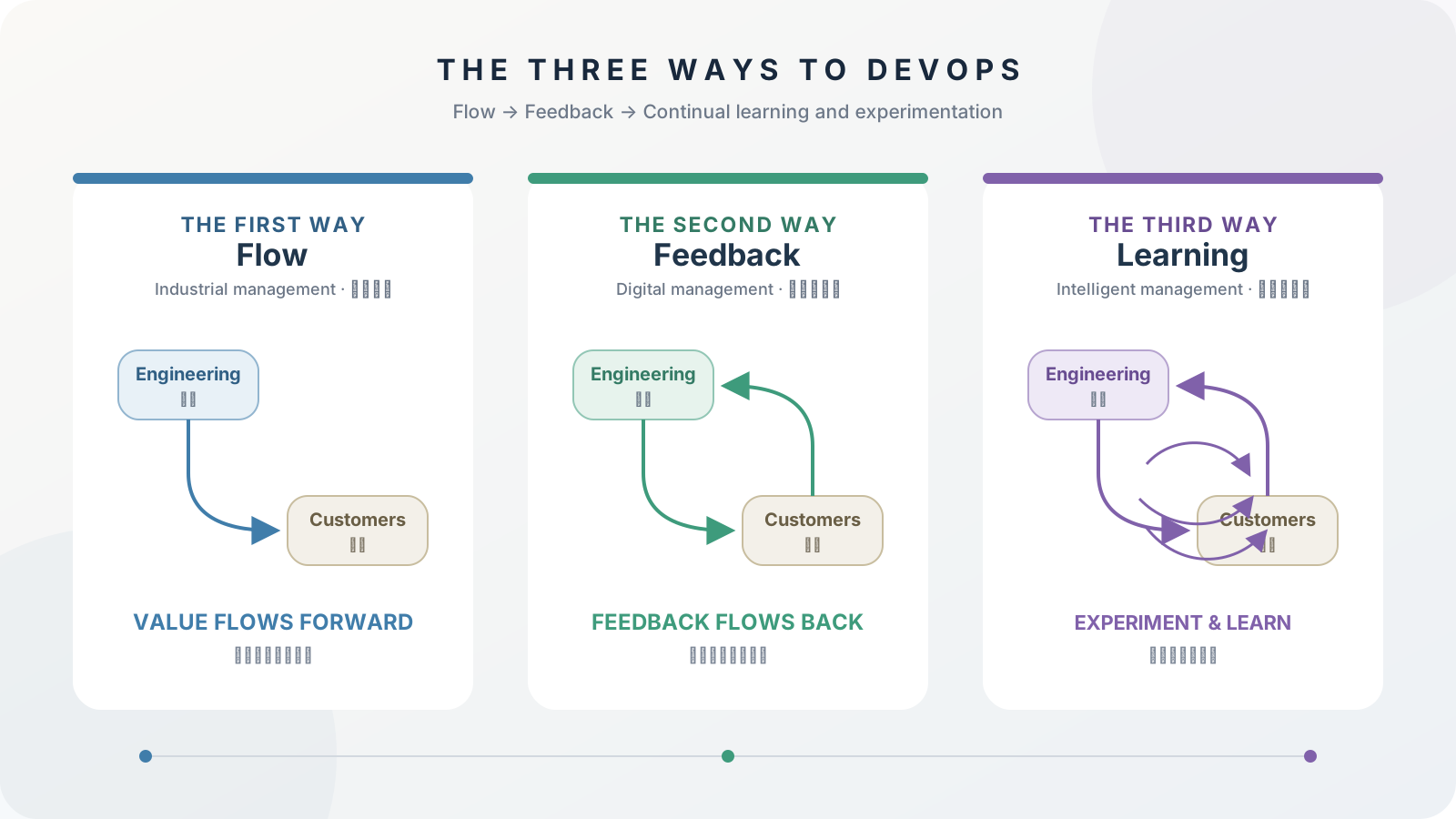
The essence of the intelligent era is moving toward the learning principle. The exponential growth of business semantic complexity poses fundamental challenges to enterprises’ ability to actively create knowledge. In the AIDD field, the inherent complexity of pharmaceutical R&D is mapped to semantic space, transforming human experience from static knowledge subjects into “emergent capabilities” that can be sustainably iterated in the business logic-data-algorithms cycle.
The pharmaceutical industry’s “10 years, $1 billion” curse is dissolving in the evolution of evolutionary organizations. Hopefully, our generation of practitioners can witness the arrival of this new era together!